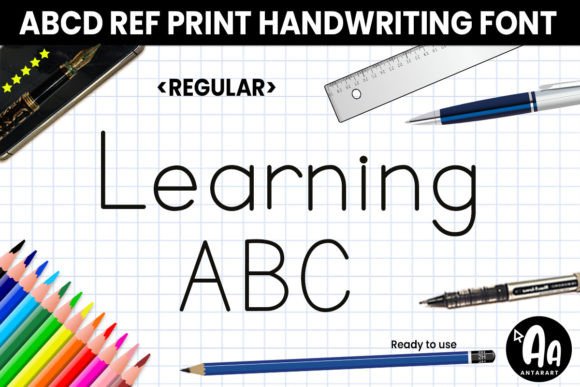
Abcd Ref Regular: The Practical Font for Educational Design
There is a specific kind of project that requires a typeface to do more than just look good; it needs to teach. When you are designing a worksheet for a child, creating a guide for handwriting practice, or building educational materials, the aesthetic flair of a complex serif font or a loose script font becomes a hindrance. This is where Abcd Ref Regular steps in. It is not just a display font; it is a functional tool rooted in the D’Nealian method, a style of cursive and block lettering taught in US schools. For designers, educators, and content creators, this premium font offers a bridge between professional design standards and educational utility.
The D’Nealian Connection: Why Method Matters
To understand the value of Abcd Ref Regular, you have to look at its foundation. The D’Nealian method was developed to ease the transition from printing to cursive writing. Unlike the traditional block letters most of us learned, D’Nealian letters have a slight slant and tails (entry strokes) that prepare the hand for connecting letters later. If you are creating educational content, using a standard sans serif font like Arial or Helvetica is often incorrect from a pedagogical standpoint. It teaches a form that children are not being asked to replicate in the classroom.
Abcd Ref Regular captures the nuances of this specific style. The letterforms are legible, open, and consistent. They do not carry the baggage of complex ligatures or decorative swashes. For a publisher or a small business owner creating educational kits, this typeface ensures that your product aligns with modern classroom standards. It is a creative font that solves a specific problem: how to make learning materials look professional while remaining strictly functional.
Visual Characteristics and Personality
Visually, Abcd Ref Regular strikes a balance between a modern typography aesthetic and a hand-drawn feel. It is a display font because of its clear construction, but it functions effectively as a text font in large educational headers or tracing guides. The personality of the font is approachable and instructional. It feels friendly without being cartoonish. It avoids the coldness of geometric sans-serifs, offering a softer, more organic rhythm that mimics actual handwriting.
Because it is based on the US school standard, the font carries an inherent sense of authority in educational contexts. It looks "correct" to parents and teachers. This perception is crucial for brand identity. If you are selling printable worksheets on Etsy or designing a cover for a workbook, the font choice signals to the buyer that the content is legitimate and follows established educational methods.
Real-World Applications for Creators and Marketers
While the primary use case is education, the utility of Abcd Ref Regular extends into various creative fields. It is a versatile design asset that can be used to evoke nostalgia, innocence, or clarity.
Educational and Publishing Projects
This is the font's home turf. Use Abcd Ref Regular for tracing sheets, flashcards, alphabet posters, and literacy apps. In editorial design, it works beautifully for headlines in magazines or blogs targeting parents, teachers, or homeschoolers. The clarity of the letterforms ensures that children can distinguish between similar characters, such as 'a' and 'o', or 'I' and 'l'.
Branding and Marketing
For businesses in the childcare, tutoring, or toy industry, this font is a goldmine. It instantly communicates a focus on child development. Use it in logo design for a daycare center or a pediatric clinic. The font’s structure is robust enough for web design headers, provided the background is clean. In packaging design for children’s products, Abcd Ref Regular can be used to highlight features or instructions in a way that feels integrated with the product's purpose.
Digital and Social Media
Content creators on platforms like Instagram or Pinterest often need fonts that are legible on small screens. Because Abcd Ref Regular is a display font with high legibility, it works well for social media graphics, particularly infographics or "quote cards" related to parenting or education. It stands out against standard system fonts, giving your content a polished, custom look without sacrificing readability.
Designing with Purpose: Readability and Hierarchy
One of the most common mistakes in design is prioritizing style over substance. When working with Abcd Ref Regular, you are prioritizing substance, which often leads to better style. The font influences visual hierarchy by providing a clear, distinct voice for educational or instructional text.
However, because it is a display font with specific characteristics (the D’Nealian slant and tails), you must be careful with font pairing. You generally want to avoid pairing it with another highly stylized handwritten font or a complex script font. The visual noise would be too high. Instead, pair Abcd Ref Regular with a clean, geometric sans serif font for body text. Fonts like Open Sans, Roboto, or Lato provide a neutral backdrop that allows the educational nature of Abcd Ref Regular to shine without overwhelming the viewer.
Evaluating Project Fit
Before selecting this font, ask yourself: "Does my audience need to learn from this text?" If the answer is yes, this is likely your best bet. If you are designing a high-fashion lookbook or a tech startup's annual report, this font will probably feel out of place. Its personality is warm and instructional; it does not carry the cold authority of a serif font like Times New Roman or the sleek minimalism of a Swiss-style sans-serif. Respect the font's voice. Use it where clarity and education are the primary goals.
Practical Guide to Implementation
Integrating a new typeface into your workflow requires more than just a download. Here is how to get the most out of Abcd Ref Regular.
- Check the Styles: A good premium font often comes with variations. Check if the family includes bold weights or italic versions. Consistency across weights is vital for brand identity.
- Test for Tracing: If you are using this for worksheets, you need to test how it looks at very light opacity (e.g., 15-20% gray). The letterforms need to remain solid enough to be traced over with a pencil or crayon. Thin, delicate fonts often fall apart at low opacity; Abcd Ref Regular is designed to hold up.
- Commercial Licensing: Always verify the license. If you are selling the worksheets you create, you need a commercial license. This protects you legally and ensures the font creator is compensated for their work. Do not assume a "free for personal use" license covers your Etsy shop.
- Spacing and Kerning: Educational fonts often require generous tracking (letter spacing). When setting headlines with Abcd Ref Regular, give the letters room to breathe. This makes the text easier to read and mimics the spacing found in primary school writing paper.
Conclusion: A Strategic Asset for Niche Design
In the vast sea of typography options, Abcd Ref Regular stands out as a specialized tool. It is not trying to be everything to everyone. It is a creative font built on a specific pedagogical method, offering immense value to a targeted audience. For designers, marketers, and creators in the educational space, it eliminates the guesswork of finding a font that is both aesthetically pleasing and instructionally sound.
By incorporating this font into your library, you are equipping yourself to produce professional, high-quality educational materials. Whether you are a freelancer building a client's brand, a publisher laying out a workbook, or a hobbyist making flashcards for your own children, Abcd Ref Regular provides the visual foundation you need. It proves that practical, functional design can also be beautiful, engaging, and deeply effective.