Unleash Playful Charm: Designing with the Honey Bear Typeface
If you’ve ever struggled to find a typeface that feels genuinely fun without looking amateurish, let me introduce you to a game-changer. Honey Bear isn't just another display font; it’s a personality packed into letterforms. As designers, we often get bogged down in the seriousness of corporate minimalism. While sans serif fonts have their place in body text, sometimes a project demands a voice that is louder, bolder, and infinitely more friendly. That is exactly where this premium font shines.
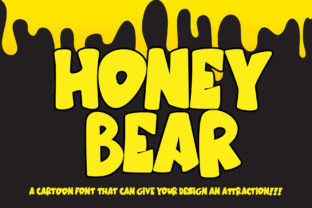
Visually, Honey Bear is characterized by its soft, rounded terminals and slightly irregular baselines. It mimics the organic imperfection of hand-lettering, giving it a tactile quality that digital text often lacks. Think of the texture of honey—thick, sweet, and sticky. This typeface captures that aesthetic through bold strokes and a cartoon-like structure that feels approachable and nostalgic. It doesn't just sit on the page; it jumps off the screen, demanding attention while maintaining a sense of whimsy.
The Visual Power of a Cartoon Aesthetic
When we talk about modern typography, we are often discussing clarity and grid systems. Honey Bear throws the rigid grid out the window in favor of personality. The visual characteristics of this font—chunky letter shapes and generous spacing—create an immediate emotional connection with the viewer. It evokes memories of childhood storybooks, retro signage, and Saturday morning cartoons. This makes it an incredibly effective tool for brand identity, particularly for brands that want to position themselves as approachable, creative, or family-oriented.
Consider the difference in perception. A generic sans serif font might tell your audience that you are professional and efficient. A sleek serif font suggests tradition and authority. But Honey Bear? It tells your audience that you are here to have a good time. It suggests creativity, warmth, and a lack of pretension. For a logo design, this is invaluable. If you are launching a boutique bakery, a toy store, or a creative workshop, this typeface instantly communicates your brand’s vibe before the customer even reads the copy.
Strategic Applications: Where Honey Bear Fits Best
Understanding where to deploy a display font is half the battle. Because of its strong personality, Honey Bear is not designed for long-form body text. Trying to read a 500-word blog post in this style would be exhausting. However, for short, punchy headlines, it is unbeatable.
Packaging Design and Retail
In the world of packaging design, shelf appeal is everything. Honey Bear excels here because its rounded, heavy strokes are legible even from a distance. Imagine this font on a jar of artisanal jam, a box of organic cereal, or a bag of coffee beans. It creates a "handmade" feel that suggests care and quality. It pairs beautifully with simple kraft paper textures or bright, solid color blocks.
Digital Presence and Social Media
In web design and social media graphics, attention spans are short. You need a header that grabs the scroller's thumb and forces them to stop. Honey Bear provides that visual anchor. It works exceptionally well for YouTube thumbnails, Instagram story headers, and call-to-action buttons. The bold weight of the font ensures high contrast, which is crucial for accessibility and mobile viewing.
Editorial and Publishing
If you are working on editorial design for a magazine cover or a children's book, Honey Bear offers a fantastic alternative to standard headline fonts. It brings energy to the layout. For bloggers and content creators, using this font for section headers can break up the monotony of text-heavy pages, making the reading experience more dynamic and engaging.
Mastering Font Pairings and Hierarchy
The mark of a skilled designer is knowing how to balance contrasting elements. Honey Bear is a loud, expressive voice, so it needs a quieter partner. This is where font pairing becomes critical.
Because Honey Bear is a creative font with high visual weight, you should pair it with a clean, neutral typeface for your body copy. A simple geometric sans serif font like Roboto, Montserrat, or Open Sans works perfectly. The neutrality of the body text allows the headlines to pop without creating visual chaos.
Avoid pairing it with other decorative fonts, such as an elaborate script font or a textured handwritten font. Two competing "loud" voices will confuse the reader and muddy your visual hierarchy. Let Honey Bear be the star of the show, supported by a cast of reliable, legible utility fonts.
Practical Usage: Licensing and Technical Fit
Before you integrate any commercial font into a client project, you must verify the licensing. Honey Bear is a premium font, which usually means it comes with a license that covers both personal and commercial use. However, always double-check the specifics if you are designing for a large corporation or creating merchandise for resale. Respecting licensing ensures that type designers can continue creating these high-quality design assets.
From a technical standpoint, check the font file for stylistic alternates or ligatures. Many high-quality display fonts include variations of specific letters (like 'a' or 'g') that can help you customize the look further. If the font includes a set of catchwords or matching icons, use them! These extras can elevate a simple layout into a cohesive branding system.
Design Observations and Final Thoughts
I’ve seen many designers shy away from "themed" fonts because they fear looking unprofessional. This is a misconception. Professionalism comes from context and execution. Using Honey Bear for a law firm website? Probably a bad idea. Using it for a startup that sells eco-friendly toys? It’s a stroke of genius.
The appeal of Honey Bear lies in its honesty. It doesn't pretend to be something it's not. It is playful, loud, and cartoonish, and it owns that identity. In a market saturated with cold, corporate branding, a little bit of warmth goes a long way.
When you are next sketching out ideas for a brand identity or a marketing campaign, consider the emotional temperature of your typography. If you need to inject joy, nostalgia, or creative energy into your work, don't settle for a standard font. Reach for something with character. Honey Bear provides that distinct voice, helping you create designs that aren't just seen, but felt. It transforms standard text into a visual experience, proving that great design doesn't always have to be serious to be successful.